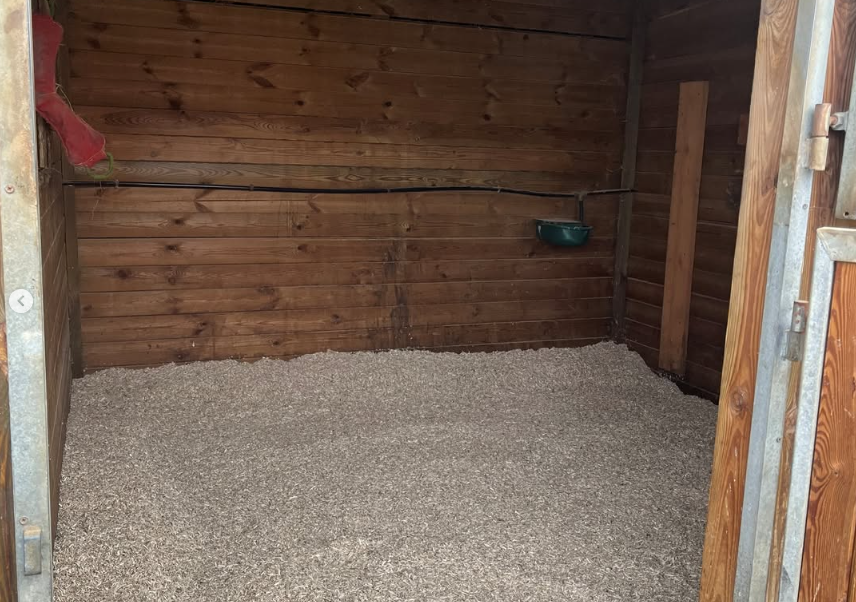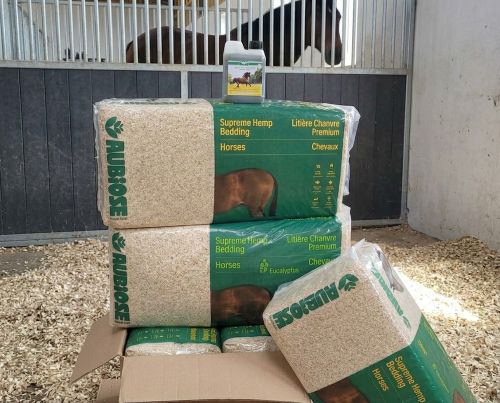
There’s no such thing as the perfect bedding. There is, however, a bedding that suits your horse, your stable or field shelter, and the way you work. Straw is still comfortable to lie on, but it absorbs little and can be dusty. Plant-based beddings such as flax and hemp absorb far more, at a higher price per bale. Here’s how to compare them on the criteria that really matter.
5 criteria for choosing horse bedding
Absorbency. The more a bedding absorbs, the less you need to top up and the less you muck out. It’s the criterion that has the biggest impact on your workload.
Dust. In the stable, your horse breathes in its bedding all day long. For a horse with a sensitive respiratory system, this is the number one criterion.
Palatability. Some horses eat their bedding. With straw this can be a plus; with other materials it’s a risk.
The real cost. The price of a bale tells you nothing on its own. What counts is how much you use each month.
Muck heap. The volume of manure and how easy it is to put to good use (composting, spreading on land) vary a lot from one bedding to another.
Horse bedding comparison
| Criterion | Straw | Wood shavings | Flax | Hemp |
|---|---|---|---|---|
| Ammonia released laboratory test, lower = better |
178.0 | 155.2 | 133.7 | 144.6 |
| Ammonia binding higher = better |
4% | 44% | Not reported | 60% |
| Dust | High | Depends on quality | Varies between studies | Low (dust-extracted 3 times) |
| Edible | Yes | No | May be nibbled | May be nibbled |
| Price per bale | Lowest | Medium | High | High |
Sources: ammonia released, Fleming et al. (2008), Journal of Equine Veterinary Science. Ammonia binding, Airaksinen et al. (2001), Journal of Equine Veterinary Science. Straw dust, Fleming et al. (2008). Hemp dust extraction according to Aubiose.
Straw: comfortable and cheap to buy, but not very absorbent
Straw has real advantages. According to the IFCE (the French Horse and Riding Institute), horses spend more time lying down on straw than on shavings or pellets. It’s also a source of fibre. However, the IFCE recommends that straw should make up no more than 30% of the forage ration, as eating too much of it can cause colic.
Its drawbacks: it binds very little ammonia, gets soiled quickly and needs frequent mucking out. Poor-quality straw also gives off dust and mould spores, which is a real problem for sensitive horses.
Wood shavings: clean, inedible, but variable in quality
Shavings absorb better than straw and horses don’t eat them. They’re a practical option for a horse that tends to eat its bed. How dusty they are depends heavily on quality, so choose dust-extracted shavings.
Flax: highly absorbent and popular in racing yards
Flax absorbs a lot and produces little dust. It’s widely used in the racing world. One thing to watch: some horses eat it, so keep an eye on your horse for the first few days.
It’s on a par with hemp when it comes to absorbing ammonia.
Hemp: absorbent, low in dust, less muck
Aubiose hemp bedding absorbs up to 4 times its own volume. It is mechanically dust-extracted three times, for a stated dust content of less than 0.1%. It’s a good option for horses that spend a lot of time in the stable or whose airways need particular care.
Thanks to this absorbency, you only remove the soiled areas. The rest of the bed stays in place. The result: fewer bales used and less muck to deal with.
According to a Finnish study published in 2001 in the Journal of Equine Veterinary Science (Airaksinen et al.), hemp binds 60% of ammonia, compared with 44% for shavings and 4% for straw.

More expensive to buy, more economical to use
A bale of hemp costs more than a bale of straw. But with hemp, you never have to strip out the whole stable. You remove droppings every day and the damp layer only when it’s saturated. After that, maintenance takes half a bale to one bale a week.
Straw works differently. In a 2023 trial run by the IFCE at Le Pin-au-Haras, in 12 m² stables, the beds were fully stripped every 15 days. Every full strip-out means a whole new bed to buy and a load of muck to get rid of.
To compare, don’t look at the price of a bale. Work out what you spend over a month.
Hemp or flax: what’s the difference?
The two beddings are similar: plant-based, absorbent and low in dust. Aubiose hemp is grown in France, without irrigation, pesticides or GMOs, by the La Chanvrière cooperative.
The limitations of hemp bedding
The price per bale is higher. The gap narrows over time, because you never strip out the whole stable (see above). To make a fair comparison, work out your cost over a month: the number of bales used multiplied by the price per bale. With Aubiose, maintenance takes half a bale to one bale a week, after an initial set-up of 6 bales for a 9 m² stable.
Setting up requires a large initial volume. You need to build a deep bed from day one. For exact quantities, see our guide.
Some horses may nibble it. As with flax, make sure there’s plenty of hay in the rack.
It’s mainly available from specialist equestrian retailers, but you can also buy it online directly from our shop.
Which bedding for your situation?
- Your horse coughs or has sensitive airways: a dust-extracted bedding (hemp, flax, dust-extracted shavings).
- Your horse eats too much of its bedding: shavings, which are inedible.
- Your horse spends a lot of time in the stable: a highly absorbent bedding (hemp, flax), so you can muck out less often.
- You’re on a tight budget and your horse lives mostly outdoors: good-quality straw is still a sound option.
- You want to cut your mucking-out time and the size of your muck heap: hemp or flax.

The right choice, in a nutshell
Straw wins on price per bale and comfort for lying down. Flax and hemp win on absorbency, dust and time spent in the stable. Hemp adds French production, no pesticides and less muck. Before you decide, compare your monthly usage, not the price of a bale.
Frequently asked questions about choosing horse bedding
What is the best bedding for a horse?
It depends on the horse. For a horse with sensitive airways, choose a dust-extracted bedding such as hemp or flax. For a horse that eats its bed, go for shavings.
Is hemp bedding more expensive than straw?
Per bale, yes. Over time, the gap narrows because you use less of it. Do the maths with your own usage.
Hemp or flax for a horse?
Both are absorbent and low in dust. The choice comes down to local availability, price and origin.
What bedding is best for a horse with a cough?
A dust-extracted bedding: hemp, flax or dust-extracted shavings. Ask your vet for advice if the cough persists.